
Home › Communal area cleaning › Communal area cleaning guide
How to specify, price and check communal area cleaning: a guide for managing agents and building managers in London
Communal area cleaning is the routine cleaning of the parts of a building that no single occupier controls: entrances and lobbies, stairs and landings, corridors, lift cars, bin and cycle stores, and the paths around the building.
In a residential block the cost is normally recovered through the service charge; in an office or mixed-use building it sits in the landlord's or managing agent's budget. This guide is for the person who buys the service and answers for it: how to write a specification that cannot be read two ways, what makes one building take longer to clean than another, how to compare quotations on equal terms, what a visit record should prove, and what happens when the cleaner finds something broken. It is written by 3COL Maintenance Services, which cleans and maintains buildings across Central London, with official sources linked wherever the law is involved. The tables, checklists and timelines below are good practice you can ask of any contractor; they are not a statement of what 3COL provides, which is set out in "How 3COL works on communal areas" near the end.
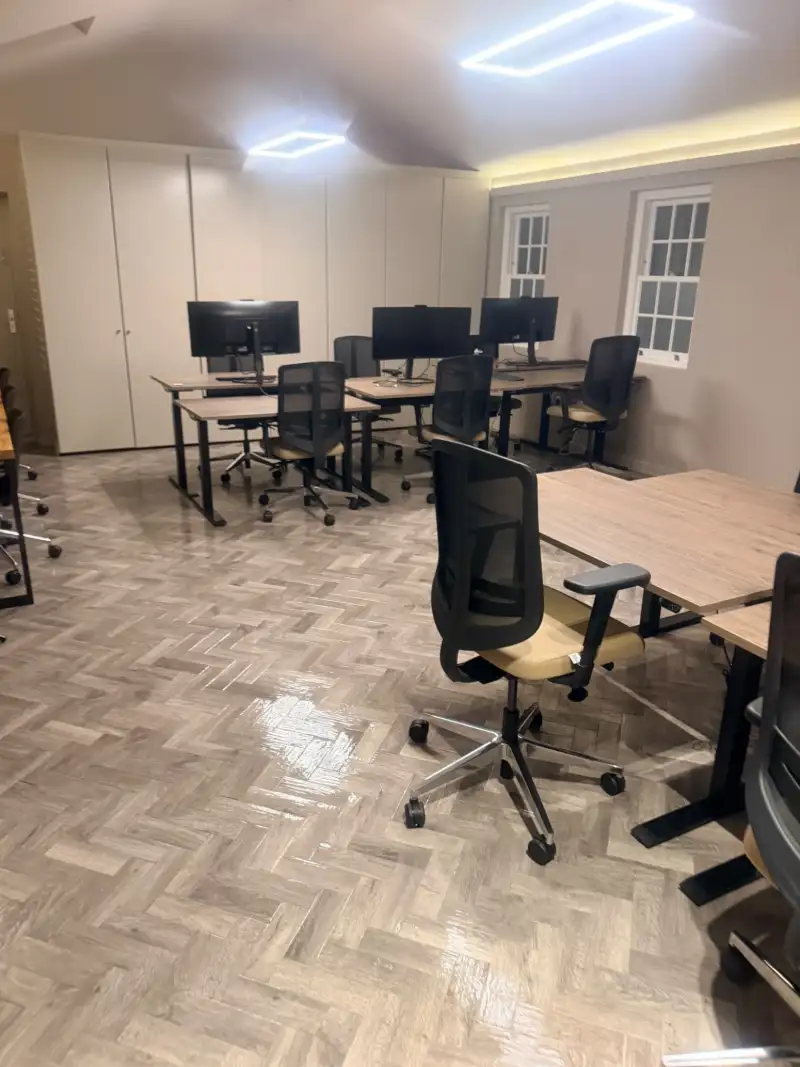 An office we clean
In short
- Specify by zone and task, with a frequency and a method of checking on every line. "Clean the communal areas weekly" is a wish, not a specification.
- The cost follows the time on site. Floors, lifts, bin stores, footfall, access and frequency matter more than the number of flats.
- Compare quotations in hours on site per month and in what each leaves out.
- The cleaner reports; the responsible person decides. A cleaning visit never replaces fire door checks or a fire risk assessment.
- A visit record is worth having only if it shows when, what was done, what was not, and what was found.
Who is responsible for what
Settle who does what on paper before the first visit.
| Party | Usually responsible for | What it means for the cleaning contract |
|---|---|---|
| Landlord, freeholder, RMC or RTM company | Keeping the common parts as the leases or tenancies require | The contract is in its name or the agent's. The leases decide whether the cost can be recovered |
| Managing agent or building manager | Specifying, instructing, checking and accounting for the cost | Owns the specification, the visit records and the defect log |
| Responsible person for fire safety | General fire precautions in the common parts, including escape routes and, in taller blocks, communal fire door checks. Who this is depends on who has control of the premises: for example the freeholder, an RMC or RTM company, or a managing agent acting for them | Receives the cleaner's fire observations. The duty does not pass to the cleaner |
| Cleaning contractor | Delivering the specification safely: risk assessments, COSHH assessments where products are hazardous, a safe method for any work at height | Should record each visit and report what it finds; worth writing into the specification |
| Residents and occupiers | Their own premises, waste presented correctly, belongings kept out of common parts | Their habits drive the bin store workload |
| Specialists | Lifts, gas, fire alarms, emergency lighting, water hygiene, high external glazing | Outside the cleaning scope; the cleaner reports visible faults |
In a mixed-use building, write the commercial entrance and the residential core as separate zones with their own hours, so the cost can be allocated to the right service charge schedule.
Write the specification zone by zone
Each line should say what is cleaned, its frequency, the result expected and how anyone will know it was done. Our companion specification table adds periodic tasks and a building details sheet.
| Zone | Routine tasks | Frequency options | How it is checked |
|---|---|---|---|
| Entrance and lobby | Door glass, entry panel, letter plates, mat lifted and cleaned beneath, floor | Every visit; daily in busy buildings | Dated photograph from a fixed viewpoint |
| Stairs, landings, corridors | Floors, handrails, door furniture, light switches; skirting spot-cleaned | Every visit; skirting monthly | One floor, chosen by the agent, walked unannounced |
| Lift cars | Walls, mirror, control panel, floor, door faces on each landing | Every visit | Photograph of the car interior |
| Bin store | Floor swept and washed, spillages removed, outsides of bins wiped | Weekly or every visit, timed after collection day | Photograph after cleaning; contamination noted |
| Cycle store, car park, paths | Litter picked, entrances swept, leaves cleared at doorways | Weekly to monthly; more often in autumn | Photograph of each entrance |
| Periodic work | Internal glass, carpet deep clean, hard floor machine clean, high-level dusting | Monthly to annually, on a dated plan | Before and after photographs on the agreed date |
Then write down what is not included: the inside of flats and offices, plant and meter rooms, roofs, glazing out of reach and the removal of dumped items. Bulky items left in a bin store should be recorded and reported to the managing agent, who arranges removal through the building's waste contractor, the council or a registered waste carrier whose registration covers that waste. Under the waste duty of care, business waste may only be handed to an authorised person.
What drives the cost, and why we do not publish a price list
Communal cleaning is priced mostly on time: hours on site, plus travel, products and supervision. Two blocks with the same number of flats can need very different time, which is why every 3COL cleaning quotation follows a free site visit. Give every bidder the same facts.
| Factor | Why it changes the time on site | What to tell bidders |
|---|---|---|
| Floors and cores | More flights and landings to cover on every visit | Storeys, cores, floors served by each core |
| Lifts | Each car is a separate clean, with doors on every landing | Number of lifts and floors served |
| Footfall | Deliveries, prams, bicycles and a busy shop entrance soil floors faster | Number of flats or occupiers, any ground-floor business |
| Bin stores | Number, size, distance from the core, condition after collection | Stores, collection days, recurring contamination |
| Frequency | Many short visits carry more travel and set-up than fewer longer ones | The frequency you want and the busiest days |
| Access and travel | Waiting for keys or a concierge uses paid time; Central London parking, loading rules and the Congestion Charge zone add cost | Key or fob arrangements, concierge hours, parking or loading bay |
| Products | Washroom supplies or specialist floor products may be included or extra | Who supplies what; any preference for eco-friendly products |
| Height | Anything out of reach needs a work at height plan, sometimes specialist access | Stairwell windows, atrium glass, high fittings |
| Starting condition | A neglected building may need a deep clean before routine visits hold the standard | When the last deep clean took place |
How to compare three quotations like for like
- Issue one specification and one set of site facts to every bidder, and let each walk the building.
- Ask for visits per month, hours per visit and the number of operatives. Convert each quotation into hours on site per month and divide the price by it. A low total buying far fewer hours means less cleaning, not better value.
- Line up the exclusions: periodic work, consumables, bin store washing, glass, a first deep clean, absence cover, supervision.
- Ask for a sample visit record, client details removed.
- Check the term, notice and price review. More than twelve months raises the consultation question below.
- Ask for the insurance certificate, RAMS and COSHH assessments.
- Compare annual cost including VAT, as leaseholders will see it.
Service charges and consultation in England
Under section 19 of the Landlord and Tenant Act 1985, relevant costs are taken into account in a service charge "only to the extent that they are reasonably incurred", and the cost of services or works "only if the services or works are of a reasonable standard". A clear specification and dated visit records are the plainest evidence of both. This section is a summary, not legal advice.
Two points are easy to confuse. The definition: under section 20ZA, a qualifying long-term agreement is an agreement entered into by or on behalf of the landlord for a term of more than twelve months, and cleaning contracts can fall within it. The threshold: under regulation 4 of the Service Charges (Consultation Requirements) (England) Regulations 2003, consultation applies where the relevant costs in a twelve-month accounting period would make any leaseholder's contribution more than £100. A short initial term, such as three months, does not by itself settle the duration of an agreement that renews or runs on. The Leasehold Advisory Service explains the steps. The government has consulted on changing these thresholds, so ask your own adviser which rules apply before committing to a longer agreement.
Fire safety in the common parts: where cleaning stops
Article 14 of the Regulatory Reform (Fire Safety) Order 2005 requires the responsible person, where necessary for safety, to ensure that "routes to emergency exits from premises and the exits themselves are kept clear at all times". Under the Fire Safety (England) Regulations 2022, in a building with two or more sets of domestic premises, residents must be given information about fire doors. Where such a building also has a storey more than 11 metres above ground, the responsible person must check communal fire doors at least every three months, and flat entrance doors on a best endeavours basis at least every twelve months. The responsible person is the person who has control of the premises, so who that is depends on the building. These are the responsible person's duties, and a cleaning visit does not discharge them.
What a cleaner can usefully do is report: a fire door wedged open, a closer that no longer shuts, damaged glass or seals, bicycles in a stair, a missing sign. Make this a fixed section of the visit record, and never let cleaning equipment stand in an escape route or riser. 3COL does not carry out fire risk assessments.
Two duties sit with the contractor: COSHH assessments where its cleaning products are hazardous substances (many can be), and a safe method under the Work at Height Regulations 2005 for stairwell windows or high fittings, unless they are excluded.
What a good visit record contains
It should show:
- the date, arrival and departure times and an operative reference;
- each zone marked done, partly done or not done, with a reason;
- periodic tasks due that visit and whether they were completed;
- dated photographs from the same fixed viewpoints, plus anything unusual;
- fire safety observations, defects found, consumables running low and access problems.
Photographs prove something only with discipline: the same angle each visit, the date and time in the file, no residents or number plates in frame. Keep the defect log separate and carry each item forward until closed. Our companion sample visit record sets this out field by field; it is a model you can ask any contractor to follow, not a description of what 3COL issues after every visit.
When cleaning finds a defect
Cleaners walk the whole building most often, so they tend to spot leaks first. A sound routine:
- Make safe within the cleaner's competence: a wet floor sign or a cone, never electrics or anything structural.
- Photograph and log it with the exact location.
- Grade it: danger now, repair needed, or watch.
- Report danger-now items to the agent during the visit; the rest go on the record.
- The agent instructs. Nothing is repaired without an instruction.
With 3COL, the repair can be quoted on the same account and goes ahead only with your approval: building and communal area maintenance, reactive maintenance, plumbing, decorating, and electrical work by a NICEIC-registered electrician. The guarantee for each repair is stated on its quotation. For urgent faults: We aim to respond to emergencies within 4 hours in our core Central London zones (W1, WC2, EC1, EC2, SW1, SW3, SE1, E14) during opening hours. Attendance is subject to availability. There is an £80 emergency attendance fee. Gas work, fire risk assessments, legionella risk assessments and lift maintenance belong to specialists.
Red flags in a communal cleaning quotation
- A price given without anyone visiting the building.
- "Communal areas" with no list of zones.
- A monthly figure with no hours on site.
- No sample visit record, or photographs only "if needed".
- No product list and no COSHH assessments.
- A long fixed term with automatic renewal and no mention of consultation.
- An offer to "inspect fire doors" as part of the cleaning.
- No answer to: who comes when the usual operative is away?
The first 90 days
A model plan to adapt to the contract you sign.
| Period | The contractor | You |
|---|---|---|
| Before the start | Confirms the specification, keys, equipment storage, products, contacts, defect route | Sign off the specification; post a lobby notice |
| Weeks 1–2 | Takes baseline photographs, carries out any agreed deep clean, opens the defect log | Read every visit record; walk the building once |
| Weeks 3–6 | Tests frequencies against reality, such as the bin store after collection day | One unannounced spot check; note what residents report |
| Weeks 7–10 | Proposes changes: a task moved, a frequency raised or lowered | Compare the defect log with what has been dealt with |
| Weeks 11–13 | Review meeting: what changes, and the periodic plan for the year | Continue, adjust or retender before any initial term ends |
Initial terms vary, so ask every bidder what theirs is and when you can review. With 3COL, the initial term is agreed in the quotation.
When you do not need a cleaning contractor
- The leases do not allow it. If they do not provide for recovering cleaning costs, check before appointing anyone at the leaseholders' expense.
- A caretaker or porter already does it. You may need only periodic specialist work.
- The need is one-off. After works or before a sale, a single deep clean may be enough.
- The problem is a defect, not dirt. Damp staining returns however often the area is cleaned. Repair first.
- Residents run a rota. In a small block this can work, if the RMC is clear about insurance and nobody climbs ladders.
How 3COL works on communal areas
See communal area cleaning in London, and our pages for property managers and facilities managers.
- A free site visit, then a written quotation within 24 business hours of the site visit; very large or complex jobs can take longer and we confirm the expected date at the visit.
- Cleaning is invoiced monthly, payable at month-end, with no deposit; repairs are quoted and invoiced separately.
- The company holds £5M public liability insurance. Directors are DBS checked; an operative's DBS is requested where a client requires it.
- A named cleaning manager for your building, with the directors involved. Dated photographs of our cleaning work, with what is photographed and how it reaches you arranged at the site visit.
- RAMS on request.
- Eco-friendly, plant-based products or standard ones, as you choose.
- Waste: 3COL takes away only the waste its own work produces, with a waste transfer note. General, bulky and resident waste is for the building's waste contractor or the council.
Questions
Questions about communal area cleaning
What does communal area cleaning usually include?
Entrances, stairs, corridors, lift cars, cycle stores and entrance paths, and bin stores if written in, with glass and deep cleaning on a dated plan. Flats, plant rooms, roofs, high glazing and dumped items are excluded unless written in.
How often should the communal areas of a block be cleaned?
No law sets a frequency. It depends on footfall, lifts and bin stores. Set a starting frequency per zone, test it in the first weeks and adjust.
How is communal cleaning priced if you do not publish rates?
On the time the building needs, assessed at a free site visit. The written quotation follows within 24 business hours of the site visit; very large or complex jobs can take longer and we confirm the expected date at the visit.
Is Section 20 consultation needed before signing a cleaning contract?
Sometimes. A qualifying long-term agreement is one entered into by or on behalf of the landlord for more than twelve months; under the current Regulations, consultation then applies once any leaseholder's contribution in a twelve-month accounting period would exceed £100. A short initial term alone does not settle the duration. Ask your own adviser before committing.
Can the cleaner check our fire doors?
A cleaner can report what they see, such as a door wedged open or a failed closer. The checks required by the Fire Safety (England) Regulations 2022 are the responsible person's duty and are not part of a cleaning visit.
What should we receive after each visit?
Ask your contractor for a dated record: each zone marked done or not done with a reason, photographs, fire safety observations and defects, which stay on a running log until closed. With 3COL, what is recorded and how it reaches you is arranged at the site visit.
Can the same contractor deal with repairs in the common parts?
With 3COL, yes. A defect found during cleaning can be quoted on the same account and goes ahead only with your approval. The guarantee for each repair is stated on its quotation.
Start here
Request a free cleaning visit
Free site visit, then a written quotation within 24 business hours of the site visit; very large or complex jobs can take longer and we confirm the expected date at the visit.
07427 135911Mon–Fri 7am–8pm · Sat–Sun 8am–6pm