
Home › Office cleaning › Communal area cleaning
Communal area cleaning for commercial and mixed-use managed buildings in London
3COL Maintenance Services cleans the shared parts of office, multi-tenant and mixed-use commercial buildings across Central London: entrances and receptions, lift lobbies and lift cars, stairs, corridors, shared washrooms and tea points, and car parks.
Each building gets a written specification agreed at the site visit, our cleaning manager checks the work on site, and because the same company carries out repairs and planned maintenance, the faults a cleaner notices have somewhere to go. The first site visit is free, and a written quotation follows within 24 business hours of the site visit; very large or complex jobs can take longer and we confirm the expected date at the visit.
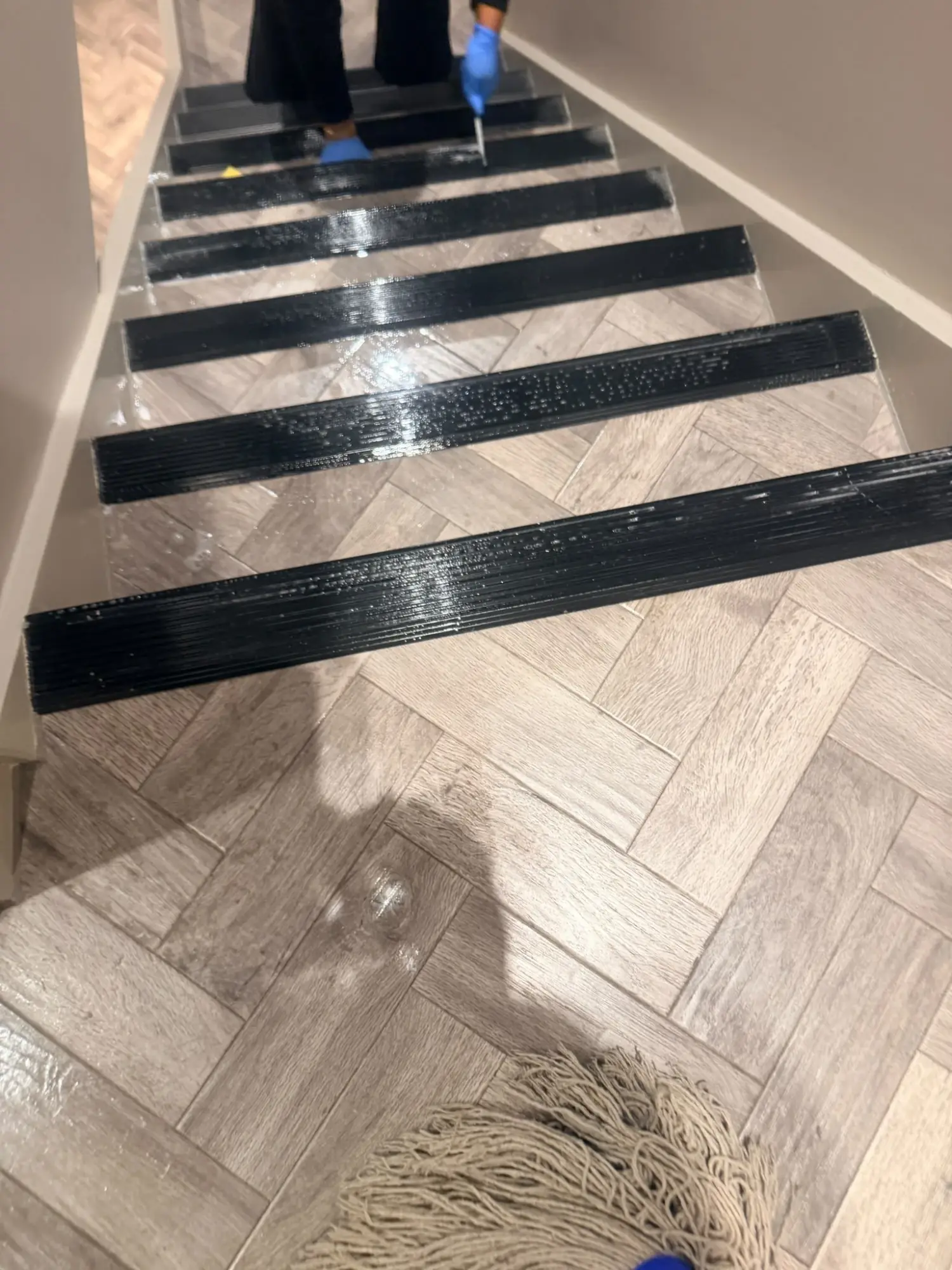 An office we clean
What counts as a communal area
A communal area, or common part, is any part of a building that no single occupier leases: the front door and reception, the lift and its lobbies, the stairs, the corridors that lead to several suites, shared washrooms, the bin store, the car park and the paths outside. Where those lines fall is set by the leases and the lease plans, not by what looks shared on the day: a tea point can be inside a tenant's demise in one building and a service-charged common part in the next.
That is why the free site visit is a walk round the building with whoever manages it, agreeing which doors the cleaner goes through and which it does not. Cleaning a tenant's lobby that the landlord is not paying for, or missing a landing that the landlord is, is an easy way for a service charge dispute to start. We clean the commercial common parts; residential parts of a mixed-use building are not part of our service.
Who is responsible for what
The table shows the usual split in a managed commercial or mixed-use building. The leases and the management agreement decide the detail for your building, so treat this as a starting point for the conversation, not as legal advice.
| Question | Landlord or freeholder | Managing agent or facilities team | Occupier | Cleaning contractor |
|---|---|---|---|---|
| Which areas are common parts | Set out in the leases and plans | Reads the leases and confirms the list | Looks after its own demise | Cleans only the areas named in the specification |
| Standard and frequency | Pays, usually recovering the cost through the service charge | Writes or approves the specification and monitors it | Reports problems to the managing agent | Carries out the specification; how visits are recorded is agreed at the site visit |
| Safety of the shared areas | Holds the duties that come with controlling the common parts | Manages them day to day for the landlord | Manages its own premises | Works to its own risk assessments and COSHH assessments; RAMS on request |
| Fire risk assessment | Depends on who has control of the premises: often the landlord, or the managing agent acting for it | Arranges the assessment and acts on its findings where it has that role | Fire safety inside its own premises | Does not carry out fire risk assessments |
| Repairs and defects | Repairing obligations under the leases | Instructs and approves the work | Reports defects as its lease requires | Repairs only when quoted and approved |
| Waste | Provides the bin store and the collection arrangement | Organises the waste contractor or council collection and access | Separates its waste and takes it to the store as agreed | Cleans the store only if the specification includes it; does not collect general or bulky waste |
The Workplace (Health, Safety and Welfare) Regulations 1992 place duties, including keeping workplaces sufficiently clean, on the person who has control of the workplace in connection with a business. Whether and how they apply to the common parts of your building depends on who has that control. A written specification helps show what "sufficiently clean" means for your building.
A specification written area by area
Every quotation is built on a specification like this one, adjusted at the site visit. Frequencies are options, not a package. The last column shows checks that can be agreed; what is used for your building is settled at the site visit.
| Area | Typical tasks | Frequency options | Checks that can be agreed |
|---|---|---|---|
| Entrance and reception | Glass doors and side panels, entrance matting, reception desk front, touchpoints, hard floor or carpet | Each visit; matting deep-cleaned periodically | Dated photographs; cleaning manager site checks |
| Lift cars and lift lobbies | Mirrors, wall panels, control panels, floor; lobby floors and call buttons | Each visit | Agreed at the site visit |
| Stairs and landings | Sweeping and mopping or vacuuming, handrails, spindles, skirting, window sills | Each visit, weekly or fortnightly by floor | Cleaning manager site checks |
| Corridors | Floors, door furniture on shared doors, light switches, skirting, high-level dusting | Each visit; high-level dusting monthly or quarterly | Cleaning manager site checks |
| Shared washrooms | Toilets, urinals, basins, mirrors, floors, consumables refilled, sanitary units where contracted | Daily or on each visit | Agreed at the site visit |
| Tea points and shared kitchens | Worktops, sinks, appliance exteriors, floors, bins | Daily or on each visit | Agreed at the site visit |
| Bin stores | Whether the store is included, and what is done there, is agreed at the site visit. Collection of general and bulky waste stays with the building's waste contractor or the council | Where agreed | Agreed at the site visit |
| Car park and ramps | Litter picking, sweeping of pedestrian routes and stair cores, spillage removal; pressure washing as a periodic item | Weekly, monthly or periodic | Dated photographs when done, if agreed |
| Internal glass and windows | Internal partitions and reachable glass; external and high-level glass quoted separately with suitable access equipment | Monthly, quarterly or periodic | Agreed at the site visit |
Periodic items, such as carpet deep cleaning, pressure washing and external glass, appear as separate lines on the quotation, so the regular cost and the occasional cost can be allocated to the right budget or service charge heading. You choose eco-friendly, plant-based products or standard ones; products are assessed under COSHH and safety data sheets are available on request.
What a visit record shows
A record that is useful to a managing agent answers four questions: who attended, when, what was done against the specification, and what was seen that needs someone else's attention. 3COL takes dated photographs of its cleaning work. What is photographed, how often, and how the record reaches you is arranged with you at the site visit, so that it fits the way you report to the landlord and the occupiers.
Our cleaning manager looks after your building, checks the work on site and is your day-to-day contact, and the directors stay involved. If a task is missed, call or WhatsApp 07427 135911: James, our assistant, logs it and passes it to the team so it is put right on the next visit.
Faults found while cleaning, repaired on the same account
Cleaners walk every shared floor more often than anyone else, so they see a failed stair light, a door closer that no longer pulls the door shut, a loose handrail, a dripping tap or a stained ceiling tile that points to a leak above.
The service is designed so that those faults reach a company that can put them right. With your approval, the same account covers commercial handyman repairs, plumbing, painting and decorating and electrical work by a qualified, NICEIC-registered electrician. Repairs are quoted separately and only go ahead once you approve them; they are invoiced separately from the cleaning. The guarantee for each repair is stated on its quotation. For regular checks of the common parts, see building and communal area maintenance and planned preventative maintenance.
For urgent repairs: We aim to respond to emergencies within 4 hours in our core Central London zones (W1, WC2, EC1, EC2, SW1, SW3, SE1, E14) during opening hours. Attendance is subject to availability. There is an £80 emergency attendance fee. More detail is on our emergency building maintenance page.
What to ask any cleaning contractor
Whoever you appoint, these are worth asking for before the first visit.
| Ask for | Why it matters | Where 3COL stands |
|---|---|---|
| An insurance certificate | A website claim is not evidence | The company holds £5M public liability insurance and £10M employers liability insurance; the certificate lists office cleaning and is available on request |
| Risk assessments and method statements for your building | Shows the work has been planned around occupiers and visitors | RAMS on request |
| COSHH assessments and safety data sheets | Many cleaning products can be hazardous substances, and COSHH assessments are required where they are | Products assessed under COSHH; safety data sheets on request |
| Vetting of the people on site | They may hold keys and fobs to a building others work in | Directors are DBS checked; an operative's DBS is requested where a client requires it |
| Third-party health and safety accreditation | Some approved-supplier lists require one | 3COL does not hold a third-party accreditation at present; the documents above are available instead |
| Waste carrier registration | Needed if the contractor takes waste away | Registered with the Environment Agency as a lower tier waste carrier, CBDL628634, for the waste its own works produce (licensed waste carrier). 3COL does not collect general or bulky waste |
| A named contact | Someone accountable when a task is missed | A cleaning manager for your building, with the directors involved |
| Clear limits of scope | Avoids assuming the cleaner covers safety checks | We do not carry out gas work, fire risk assessments, legionella risk assessments or lift maintenance |
Changing contractor without a gap
- Check your notice. Find the notice period in the current cleaning contract and the date it can end.
- Free site visit and specification. We walk the building with you, agree the areas, tasks and frequencies, and note access arrangements such as reception hours and where equipment can be kept.
- Written quotation. It follows within 24 business hours of the site visit; very large or complex jobs can take longer and we confirm the expected date at the visit.
- Staff who may transfer. TUPE may apply to a change of cleaning contractor where there is an organised grouping of employees whose principal purpose is carrying out the cleaning for your building. This is general information, not advice: raise it early with the outgoing contractor and take advice on your own position.
- Start date and handover. The start date is agreed with you around the notice you owe. How keys and fobs are handed over, and whether starting photographs are taken, is arranged at the site visit.
- Terms. Cleaning is invoiced monthly, payable at the end of the month, with no deposit; repairs are quoted and invoiced separately. The initial term is agreed in the quotation.
What sets the cost of communal cleaning
Each building is priced after the site visit, not from a rate card. What moves the price:
- Size and layout: the number of floors, staircases and corridors, and whether there is a lift.
- How hard the building is used: the number of occupiers, visitors and deliveries passing through the entrance.
- Washrooms and tea points: how many are common parts, and whether consumables are supplied by us or by you.
- Floors and finishes: stone, timber, vinyl and carpet need different methods and different time.
- Frequency and timing: daily, several times a week or weekly, and whether visits run before opening, during the day or later in the evening.
- Bin stores and car parks: their size, and what is included.
- Periodic work: deep cleans, carpet cleaning, pressure washing and external glass, priced as separate lines.
- Access: where equipment can be stored, and any parking or vehicle costs, which are grouped in the written quotation.
Questions
Questions about communal area cleaning
Do you clean multi-tenant office buildings and mixed-use buildings?
Yes, the commercial common parts of multi-tenant and mixed-use buildings. In a mixed-use building we clean the commercial common parts; residential parts are not part of our service.
Can cleaning happen before the occupiers arrive?
Yes. We work Monday to Friday 7am to 8pm and Saturday and Sunday 8am to 6pm, so entrances and lifts can be done before the building opens and washrooms during the day if footfall needs it.
How do we know a visit actually happened?
3COL takes dated photographs of its cleaning work, and our cleaning manager checks the work on site. What is photographed and how the record reaches you is arranged at the site visit. If something is missed, call or WhatsApp 07427 135911 and it is logged and put right on the next visit.
Are your operatives DBS checked?
Our directors are DBS checked. An operative's DBS is requested where a client requires it, so tell us at the site visit if your building or any occupier needs it.
Do you hold a third-party health and safety accreditation?
Not at present. Before you appoint us we can send our insurance certificate, RAMS for your building, COSHH information and our waste carrier registration.
Can you take over from our current contractor?
Yes. The start date is agreed around your notice period, and how keys and fobs are handed over is arranged at the site visit. Check early whether TUPE applies to the outgoing contractor's staff.
How is the cost worked out?
By building, after a free site visit, using the factors above. You receive a written quotation within 24 business hours of the site visit; very large or complex jobs can take longer and we confirm the expected date at the visit. Regular cleaning and periodic items are shown as separate lines.
Related pages
- Repairs and regular checks on the shared parts: building and communal area maintenance
- For managing agents: property managers · For FM teams: facilities managers
- Office floors inside the building: office cleaning in London
- Supplier checks: choosing a compliant contractor
- Writing the brief: how to specify, price and check communal area cleaning
Start here
Request a free cleaning visit
Free site visit, then a written quotation within 24 business hours of the site visit; very large or complex jobs can take longer and we confirm the expected date at the visit.
07427 135911Mon–Fri 7am–8pm · Sat–Sun 8am–6pm